Class Presentation: Core Concepts and Evaluation Metrics of Diagnostic Accuracy

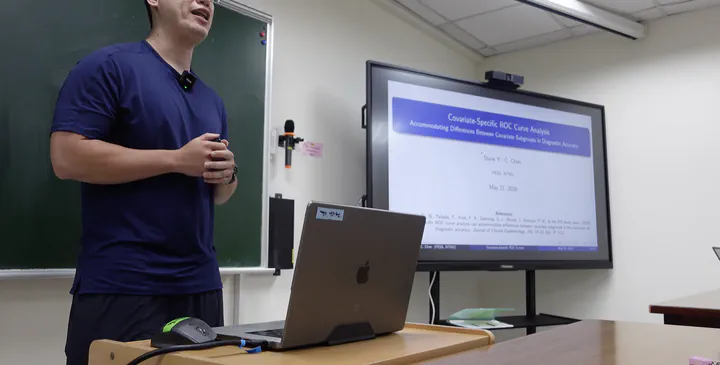 Presenter: Ying-Chu Chen
Department of Mathematics, Gongguan Campus, National Taiwan Normal University
88, Section 4, Tingzhou Rd., Taipei City, Wenshan Dist. 116
Presentation Highlights / 報告精華
Introduction & Rationale
In modern clinical practice, distinguishing between disease and non-disease states using biomarkers is a critical challenge. This presentation delves into a Q1 journal article (Impact Factor: 5.2) to explore how optimal decision boundaries are formed and how covariate-specific curves can improve diagnostic accuracy.
Key Insights
- Diagnostic Foundations: Clearly defining the “Index Test” (the new diagnostic tool being evaluated) versus the “Reference/Gold Standard” (the absolute truth, e.g., HbA1c for Type 2 Diabetes).
- Evaluation Metrics: Understanding Sensitivity (True Positive Fraction) as a cornerstone metric for ensuring accurate classification and minimizing false negatives.
- Covariate Challenges: Addressing how population differences (covariates) impact the positive thresholds, and utilizing D-dimer for Venous Thromboembolism (VTE) as a real-world clinical application scenario.
Practical Application
Accurately assessing these diagnostic metrics prevents unnecessary invasive procedures and optimizes clinical decision-making when evaluating new assessment tools.
研究動機與背景
在現代臨床實務中,利用生物標記將病患正確分類為「患病」或「未患病」是一大挑戰。本次報告深入探討一篇影響因子 5.2 的 Q1 期刊文獻,解析如何透過特定協變數曲線與指標,來容納群體間的差異並制定最佳決策邊界。
核心發現
- 診斷準確性基礎:釐清「指標測試(Index Test,即受評估的新型診斷工具)」與「參考標準(Reference Standard,即絕對真相,如檢測糖尿病的糖化血色素)」的差異。
- 核心評估指標:探討「敏感度(Sensitivity,真陽性率)」作為關鍵指標的數學邏輯,確保檢測能正確超過陽性閾值。
- 協變數的臨床應用:探討協變數干擾問題,並以 D-dimer(D-雙聚體)檢測靜脈血栓栓塞(VTE)作為實際的臨床應用案例進行分析。
實務建議
精準評估檢測工具的準確度與閾值,能有效避免病患接受不必要的侵入性醫療程序,將臨床誤診的機率降到最低。
報告紀錄與影音 (Presentation Recording)
(If the video does not display properly, you can watch it directly on YouTube.)
報告資訊 / Presentation Info
- Presenter / 報告人: Ying-Chu Chen (陳映竹), Ph.D. Candidate
- Instructor / 授課教師: Lu, Tsui-Shan, Ph.D.
- Course / 課程: Categorical Data Analysis (類別資料分析)
- Location / 地點: Department of Mathematics, Gongguan Campus, NTNU (師大公館校區數學系)
- Lab / 實驗室: Physical Activity & Cognitive Neuroscience Lab (PACNL), NTNU