The Calculus of Resilience: A Sports Scientist's Reflection on the 'Extreme Game' / 韌性的微積分:從運動科學視角解讀「極限賽局」
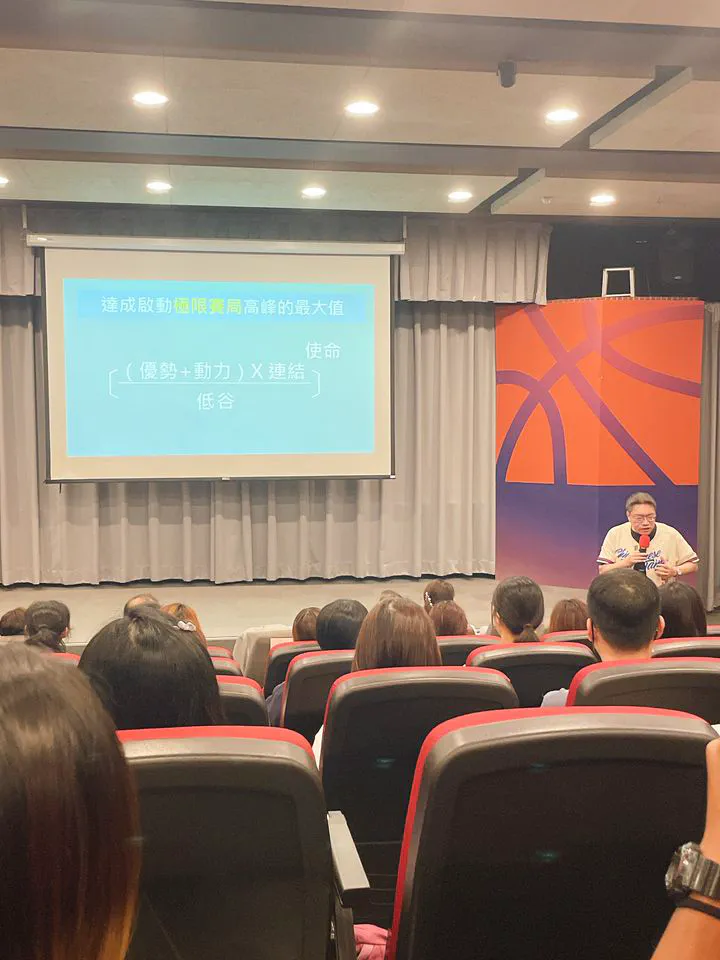 Hsieh Wen-Hsien breaking down the mathematics of the ‘Extreme Game’ / 謝文憲講師拆解極限賽局的成就公式
Taipei, Taiwan
揮棒與落空:學術生涯的打擊區 (Swinging and Missing: The Academic Batter’s Box)
As a Ph.D. candidate heavily immersed in the world of exercise science and neuroscience, my days are often consumed by empirical data, EEG setups, and statistical modeling in SAS and RStudio. It is easy to become hyper-focused on the micro-level—the precise timing of an event-related potential or the physiological response to Blood Flow Restriction (BFR) exercise. However, attending Hsieh Wen-Hsien’s “Extreme Game” (極限賽局) Master Lecture provided a much-needed macro-level paradigm shift.
Acting as the “Minister of Education” of my own intellectual world, I constantly seek ways to integrate interdisciplinary insights. 憲哥 (Brother Hsien) framed life’s challenges not as insurmountable obstacles, but as variables in a highly dynamic equation. It was a refreshing reminder that the principles governing athletic performance and cognitive enhancement apply equally to our personal and professional trajectories.
解碼成就公式:生理適應與低谷效應 (Decoding the Achievement Formula: Physiological Adaptation and the ‘Valley Effect’)
One of the most striking moments of the seminar was the presentation of the achievement formula:
[(優勢 + 動力) × 連結] / 低谷 = 達成極限賽局高峰的最大值
( [(Advantage + Motivation) × Connection] / Valley = Maximum Peak Achievement )
As a sports scientist, I couldn’t help but view this through the lens of Supercompensation (超量恢復) and Neuroplasticity (神經可塑性).
The Valley as a Catalyst (作為催化劑的低谷)
In mathematics, as the denominator (the Valley/Trough) approaches zero, the overall value of the equation approaches infinity. In sports physiology, the “valley” represents the acute fatigue and micro-trauma induced by rigorous physical training. Without this deliberate depression of our baseline state, adaptation cannot occur.
Similarly, in my research involving executive function and cognitive control, the brain requires cognitive load—a metaphorical valley of mental strain—to upgrade its neural networks. When we face academic rejections, when our code fails to compile, or when an experiment yields null results, we are situated in this denominator. The depth of this valley directly dictates the potential height of the subsequent peak, provided we maintain our motivation and seek out external connections.
認知神經科學視角下的「好教練」 (The ‘Good Coach’ Through the Lens of Cognitive Neuroscience)
During the presentation, a slide featuring a baseball coach and a young athlete displayed a profound definition:
“好的教練就是:要你做不喜歡做的事,說你不喜歡聽的話,讓你成為想成為的人。”
(A good coach is: making you do things you don’t like, saying things you don’t like to hear, to make you the person you want to become.)
This resonated deeply with my dual identity as a university lecturer teaching exercise technique and a certified CSCS/ACSM-CEP coach. Why do we naturally resist doing things we dislike? From a cognitive neuroscience perspective, breaking habitual patterns and overriding comfort requires immense Inhibitory Control (抑制控制)—a core component of our executive functions mediated by the prefrontal cortex.
A great coach essentially acts as an external prefrontal cortex for the athlete or student. By intentionally introducing stress and demanding actions outside the comfort zone (whether that is heavy squats, process-based academic writing, or active learning pedagogies like the Jigsaw method), the coach forces the individual to recruit higher-order cognitive resources. This “friction” is exactly what drives human upgrade.
知識轉譯的使命:你的舉手之勞 (The Mission of Knowledge Translation: Your Slight Effort)
Another powerful visual from the seminar stated: “你的舉手之勞,可能是別人的無能為力” (Your slight effort might be someone else’s helplessness).
This perfectly encapsulates the core mission behind “我是運科竹” (I am Sport Sci Zhu). Academic silos can often trap valuable scientific discoveries within paywalled journals and highly technical jargon. What might seem like a “slight effort” to an academic—explaining the physiological mechanisms of cardiovascular health or the cognitive benefits of acute exercise—can be life-changing for someone struggling to manage their health.
As academics, our “Connection” (the multiplier in the formula) is intrinsically linked to how well we communicate our science to the public. Expanding our influence beyond the laboratory and engaging in meaningful science communication is how we maximize our societal impact.
結語:不斷揮動球棒 (Conclusion: Keep Swinging the Bat)
The seminar concluded with a whiteboard sketch and a simple, undeniable truth: “如果您想打中球,您就必須不斷揮動球棒!!” (If you want to hit the ball, you must keep swinging the bat!!)
In research, coaching, and life, the fear of striking out often paralyzes us. However, equipped with the right motivation, a strong interdisciplinary network (Connection), and the understanding that valleys are necessary precursors to peaks, we can step into the batter’s box with confidence.
The “Extreme Game” is finite because our time is limited. But the legacy (遺澤) we leave through our virtues, our untiring spirit, and the juniors we mentor—that is infinite. Keep swinging.