Translating Filial Piety: International Sinology English Reading Clubs
 English Reading Clubs with Ying-Chu Chen
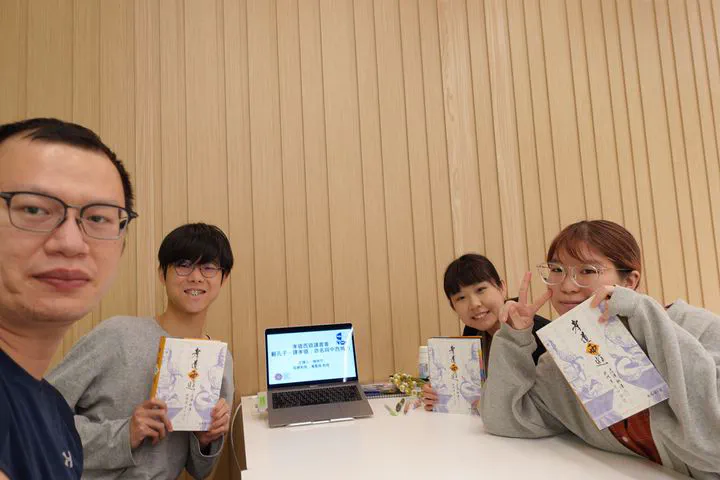
With funding from the National Taiwan Normal University Library, a recent English Reading Club session led by Ying-Chu Chen embarked on a rigorous intellectual exploration of cross-cultural translation and international sinology. The reading group focused deeply on the book The Westward Journey of Filial Piety (《孝道西遊》), authored by Professor Pan Feng-Chuan, who notably served as his advisor during his studies at the Graduate Institute of International Sinology.
Under Ying-Chu’s moderation, the discussion transcended basic textual analysis to engage with the complex history of how Chinese classics were interpreted by the West. Participants examined the book’s core case study: the translation of the Classic of Filial Piety (Xiaojing) by Western missionaries and sinologists during the eighteenth and nineteenth centuries. They dissected how translation is never a neutral act, but rather a dynamic process where translators—from François Noël to James Legge—adapted the concept of “filial piety” to fit distinct European contexts, including the Chinese Rites Controversy, imperial literature, and the rise of comparative religion.
Furthermore, the attendees grappled with the sophisticated evolution of international sinology. They analyzed Professor Pan’s proposition that these various translations functioned as a “double-sided mirror.” This framework compellingly illustrates how translated texts reveal shifts in European academic paradigms over time, while simultaneously highlighting diverse interpretations of Chinese culture. The group acknowledged that these historical translations are not mere antiquarian artifacts; they are the conceptual progenitors of modern international sinology.
The discussions challenged the participants to synthesize these historical models and apply them rigorously to the study of cross-cultural exchange. By exploring deep methodological reflections on missionary sinology, the group collectively dissected the complex architecture of how Eastern ethical frameworks were systematically reconstructed in the Western intellectual world.