Journal Meeting: Effect of sprint interval cycling with blood flow restriction on capillary blood lactate, cognitive function and perceptual response

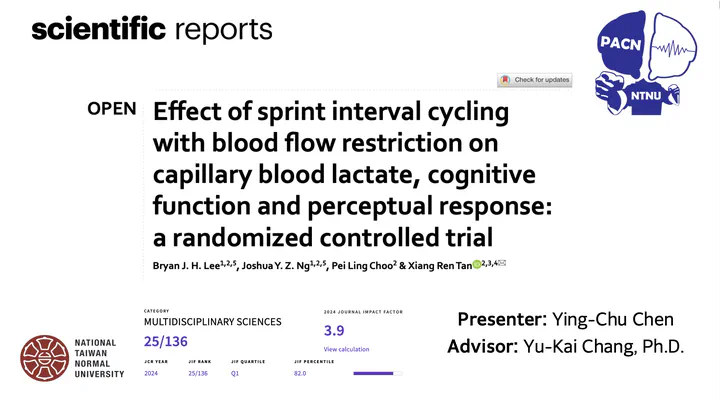 Presenter: Ying-Chu Chen
Physical Activity and Cognitive Neuroscience Lab, National Taiwan Normal University
162, Section 1, Heping E. Rd., Taipei City, Daan Dist. 106
Presentation Highlights / 報告精華
Introduction & Rationale
While HIIT is effective for brain health, its high strain often leads to poor adherence. Blood Flow Restriction (BFR) combined with exercise has been proposed as a time-efficient alternative. This study explored if BFR coupled with “all-out” 10-second sprints (SIE) could enhance metabolic stress (lactate production) and subsequently improve cognitive functions like executive control.
Key Findings
- Lactate Levels: Both BFR-SIE and SIE groups showed significant lactate increases (approx. 12 mmol/L), but BFR did not provide an additional boost over SIE alone.
- Cognitive Performance: Reaction times in the Stroop Test improved in both conditions, but no significant changes were found in working memory (Digit Span).
- Perceptual Strain: Participants in the BFR-SIE group reported significantly higher RPE (5.3 vs 4.9). The mechanical pressure likely stimulated Group III/IV afferents, reducing central motor drive and power output.
Practical Application
Applying BFR during maximal effort exercises may be suboptimal because the added discomfort can limit performance and motivation, offsetting the intended physiological benefits.
研究動機與背景
雖然高強度間歇運動(HIIT)對大腦健康有效,但其高強度常導致民眾難以堅持。結合血流限制(BFR)的訓練被視為一種高效的替代方案。本研究探討將 BFR 應用於「全速」10 秒衝刺(SIE),是否能透過增加代謝壓力(乳酸堆積)來進一步提升如執行控制等認知功能。
核心發現
- 乳酸反應:BFR-SIE 與單純 SIE 組的乳酸皆顯著上升(約 12 mmol/L),但加入 BFR 並未如預期般產生更高的乳酸值。
- 認知表現:兩組在 Stroop 測驗中的反應時間均有改善,但工作記憶(數字跨度測驗)則無顯著變化。
- 自覺努力感:BFR-SIE 組的自覺耗力程度顯著較高(5.3 vs 4.9)。這顯示壓力帶來的身體不適感可能抑制了中樞運動驅動,導致功率輸出下降。
實務建議
在進行「最大努力」或「自發性強度」的運動時,加入 BFR 可能並非最佳選擇,因為額外的知覺壓力會限制運動表現與動機,進而抵消預期的生理獲益。
報告資訊
- Presenter / 報告人: Ying-Chu Chen (陳映竹), Ph.D. Candidate
- Advisor / 指導教授: Yu-Kai Chang (張育愷), Ph.D.
- Lab / 實驗室: Physical Activity & Cognitive Neuroscience Lab (PACN Lab), NTNU
- 影片連結: https://youtu.be/ye9k6n0T6yU