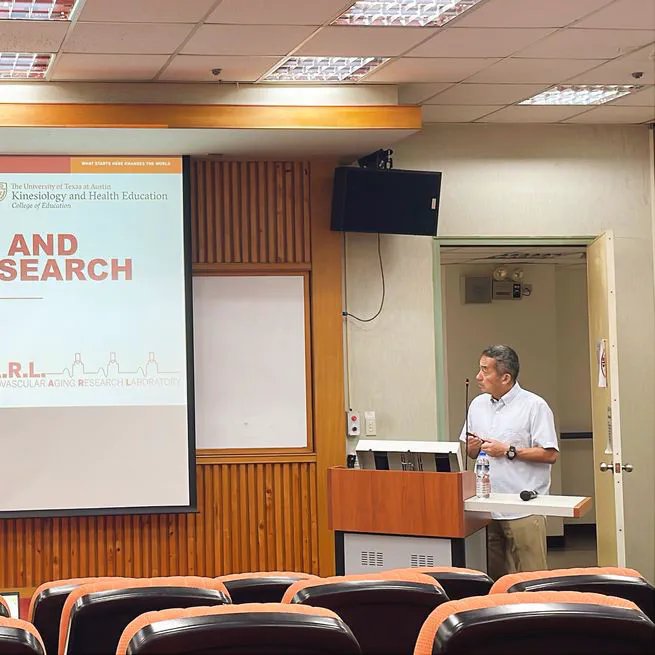
Attending Professor Hirofumi Tanaka’s lecture on “Career Path and Academic Research”
One of the most impactful messages from his talk was the emphasis on resilience and long-term vision in an academic career. Professor Tanaka did not shy away from highlighting the challenges—uncertainty, funding pressure, and the occasional failure. Yet, he encouraged us to stay committed to asking meaningful questions and pursuing research that contributes to the well-being of society, especially in fields like cardiovascular health and aging.His own journey, from early research interests to founding the Cardiovascular Aging Research Laboratory (C.A.R.L.), demonstrated how a focused research niche can evolve into a globally recognized academic identity. This point struck me deeply, especially as a graduate student still shaping my own research trajectory in exercise science.As someone who hopes to bridge exercise science and cognitive health, I found Professor Tanaka’s discussion of interdisciplinary collaboration particularly motivating. He reminded us that impactful science often arises at the intersection of disciplines and that curiosity must always guide our scholarly path. Moreover, his humble demeanor and willingness to share practical advice—such as maintaining a consistent publication rhythm, nurturing academic networks, and mentoring students—offered not just abstract ideals, but concrete steps we can take. This seminar made me reflect critically on my own career goals. Am I positioning myself to make a long-term impact? Am I choosing research questions that I deeply care about? These are not easy questions, but the talk provided a framework to begin answering them Ultimately, Professor Tanaka’s visit
May 8, 2025
Attending Professor Marius Brazaitis’ lecture on “The Benefits of Various Types of Stress for Physical and Mental Well-being”
One of the most impactful takeaways from Professor Brazaitis’ lecture was the reconceptualization of stress as a biologically essential process rather than an inherently negative experience. Through compelling physiological models and real-world examples, he emphasized that controlled stress exposure can trigger beneficial neuroendocrine adaptations, improve cognitive function, and enhance physical resilience. As someone conducting research on acute exercise and cognitive performance, I found his interdisciplinary approach highly relevant and invigorating. The lecture prompted me to reflect on how we can design interventions that harness stress adaptively rather than merely avoiding it. His message was not only scientific but also empowering: stress, when well understood, can be an ally in optimizing health.
Apr 21, 2025
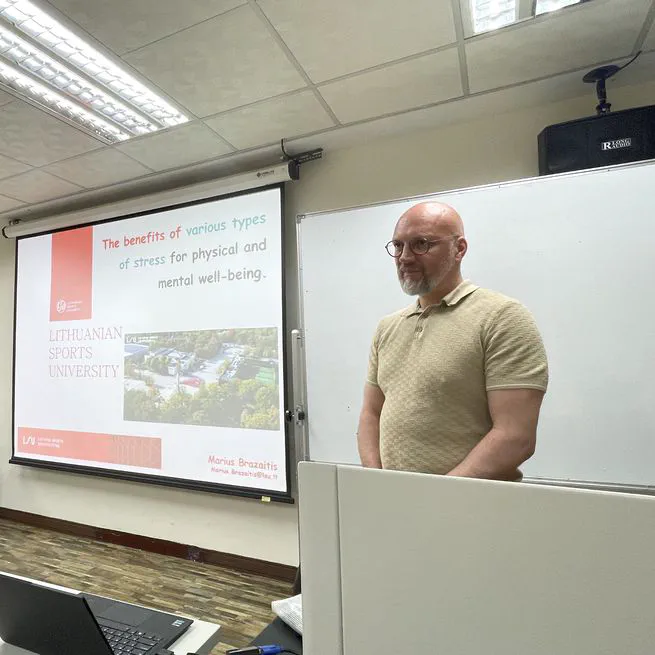
Attending Professor Marius Brazaitis’ lecture on “The Benefits of Various Types of Stress for Physical and Mental Well-being”
One of the most impactful takeaways from Professor Brazaitis’ lecture was the reconceptualization of stress as a biologically essential process rather than an inherently negative experience. Through compelling physiological models and real-world examples, he emphasized that controlled stress exposure can trigger beneficial neuroendocrine adaptations, improve cognitive function, and enhance physical resilience. As someone conducting research on acute exercise and cognitive performance, I found his interdisciplinary approach highly relevant and invigorating. The lecture prompted me to reflect on how we can design interventions that harness stress adaptively rather than merely avoiding it. His message was not only scientific but also empowering: stress, when well understood, can be an ally in optimizing health.
Apr 21, 2025