
Bridging Cardiovascular Physiology and Cognitive Science: Insights from Dr. Chueh-Lung ‘Laura’ Hwang
演講中提出了三個核心要點:首先是『血管—認知連結』,說明動脈硬化對大腦健康的深遠影響;其次是『酒精的雙相影響』,解析攝取酒精後血壓與內皮功能(NO 生物利用度)的急性變化對運動處方的意義;最後是『肌肉氧合(StO2)』的即時趨勢分析,這與我研究中的大腦氧合指標形成了有趣的平行對比。此外,我們也探討了大腦與生理的關鍵問題:規律有氧運動是否能作為酒精血管損傷的緩衝?以及高強度間奏訓練(HIIT)是否能透過血液動力學的穩定來預防酒精濫用?這些觀點對提升運動科學的臨床應用價值具有重大意義。 The session highlighted three pivotal takeaways: 1) The Vascular-Cognitive Link, detailing how arterial stiffness serves as a precursor to cognitive decline; 2) Alcohol’s Biphasic Impact, illustrating how acute changes in blood pressure and endothelial function (NO bioavailability) necessitate tailored exercise prescriptions; and 3) Muscle Oxygenation (StO2) trends, which provide a fascinating parallel to cerebral oxygenation markers. We also explored critical 'Big Questions': Can regular aerobic exercise serve as a primary buffer against vascular insults from alcohol? And could HIIT be a physiological gateway to preventing alcohol misuse through hemodynamic stabilization? These insights resonate deeply with my current focus on acute exercise interventions and BFR, highlighting the strategic synergy between physical therapy and exercise science.
Mar 20, 2026
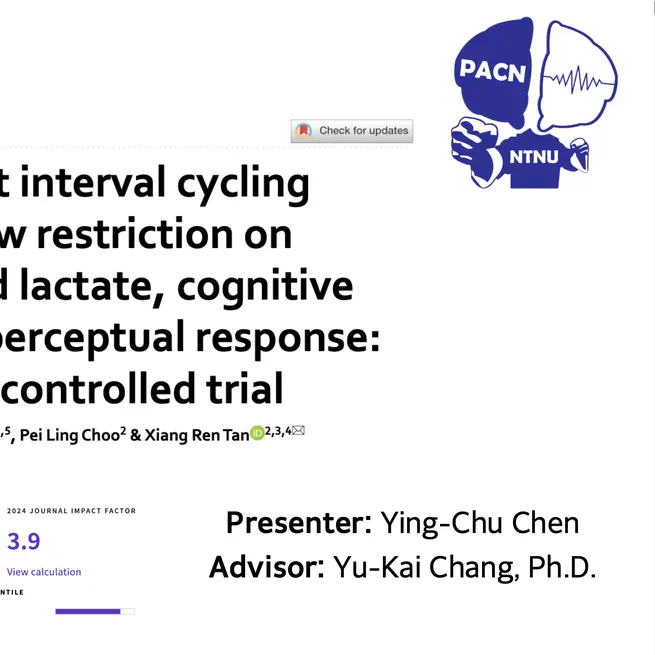
Journal Meeting: Effect of sprint interval cycling with blood flow restriction on capillary blood lactate, cognitive function and perceptual response
Ph.D. Candidate Ying-Chu Chen discusses the impact of acute BFR-SIE on metabolic stress and executive function. / 陳映竹博士候選人探討結合血流限制與衝刺間歇訓練對執行功能的影響。
Feb 25, 2026
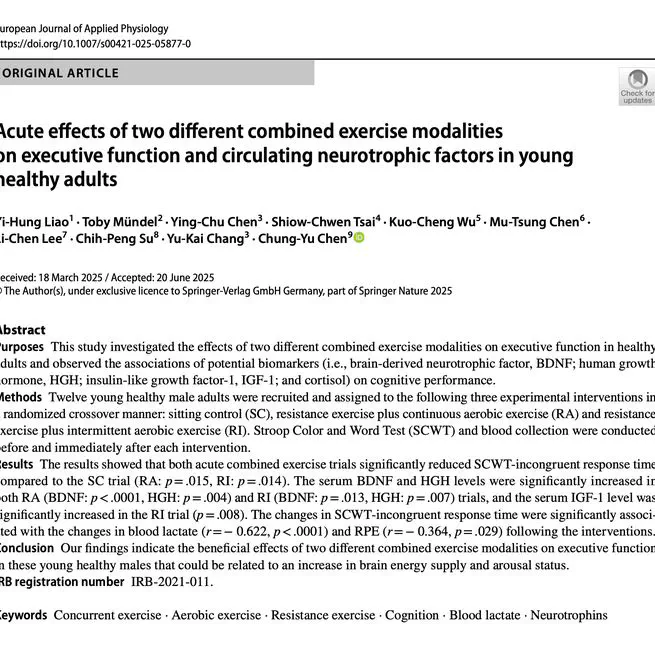
Acute effects of two different combined exercise modalities on executive function and circulating neurotrophic factors in young healthy adults
This study examined how two acute combined exercise modalities—resistance exercise plus continuous or intermittent aerobic exercise—affect executive function and neurotrophic factor levels in young men. Improvements in Stroop test performance and increases in BDNF, HGH, and IGF-1 were observed, especially after the intermittent aerobic condition.
Jun 20, 2025
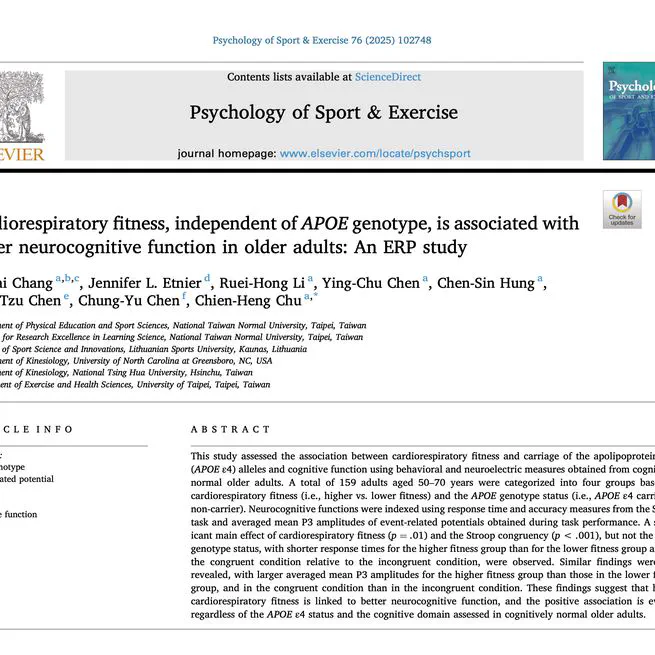
Cardiorespiratory fitness, independent of APOE genotype, is associated with better neurocognitive function in older adults:An ERP study
This study examined the relationship between cardiorespiratory fitness and neurocognitive function in older adults, independent of APOE genotype. The results suggest that better fitness is linked to faster cognitive processing and larger P3 amplitudes, highlighting the importance of maintaining physical fitness to support cognitive health in older age, regardless of genetic factors.
Jan 1, 2025

Acute effect of combined exercise with aerobic and resistance exercises on executive function
Objective: Recent studies indicate that acute exercise, whether aerobic exercise (AE) or resistance exercise (RE), improves cognitive function. However, the effects on cognitive function of combined exercise (CE), involving both AE and RE in an exercise session, remain unknown. The aim of this study was to investigate the effects of acute CE on cognitive function. Design: Within-subject design with counterbalancing. Methods: Fifteen healthy men with a sedentary lifestyle in the previous three months were recruited. The participants were assessed for muscular fitness after performing four upper body exercises for a 10-repetition maximum and underwent a submaximal aerobic fitness assessment for V̇O2peak and corresponding workload (watts). They were then assigned to a CE, RE, or sitting control (SC) session in counterbalanced order and were assessed with the Stroop Color and Word Test (SCWT) after each session. Results: Acute CE led to a significantly shorter response time compared to SC (p < .05) in the SCWT, wherein there were no significant differences between acute CE and RE (p = 1.00). Additionally, no significant differences in the accuracy rate were observed across the different sessions (ps > .05). Conclusion: A single session of moderate-intensity CE improved response time in the SCWT, comparable to RE. CE shows promise for enhancing cognitive function, warranting further research on its benefits and other exercise modalities. Keywords: Combined Exercise; Executive Function; Inhibition Control; Interference effect; Stroop Color World Test.
Aug 21, 2023